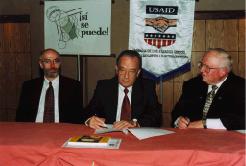
|
Certified Fraud Examiner-CFE,
CPA, CFSA, CIA, CGFM*
International Project Chief-of-Party
Anti-Corruption
Specialist – Forensic Certified Public Accountant
|
COUNTRY OF CITIZENSHIP:
USA
Permanent Residence: ECUADOR
E-Mail: jwesberry@aol.com or
jwesberry@gmail.com
Telephones: 5932- 603-5169 or 289-5082 Quito or 703-960-4520 USA
SKYPE: jimwesberry |
MAILING ADDRESSES:
P.O. Box 17-22-20297, Cumbaya
QUITO, ECUADOR or
4004 Franconia Rd.,
Alexandria, VA 22310-2136, USA |
Personal Introduction and Resume
CHRONOLOGY OF RELEVANT WORK EXPERIENCE:
James P. Wesberry, Jr. is recognized worldwide for his lifetime dedication to accountability and transparency in government. While his professional training and focus is most closely linked to financial accountability
and performance auditing, beginning with early crusades against corruption in his home state of Georgia where he authored
the code of ethics for state employees, until the past decade when he headed
the USAID AAA Hemispheric Anti-Corruption Project, then the Mexican Anti-Corruption Project ATLATL, then the Ecuadorian Anti-corruption Project Si Se Puede!, and finally the Philippine Integrity Project iPro, his has been a consistent
and powerful voice for anti-corruption reform as a speaker, trainer, consultant and project leader spanning all segments and
operations of government including the executive and its agencies, legislative and judicial. Because of his unparalleled experience
in the anti-corruption arena, he is regularly invited to speak and consulted not only on auditing and financial-management
reform, but also on such issues as government ethics agencies, inspectors general, whistleblowing, the role of civil society
and the full range of accountability issues. He has developed his own modus operandi for fighting corruption using both new and traditional practices adapted to modern technology,
especially internet websites, electronic communications, audience response and training and satellite conferencing. For these efforts he has been decorated by two governments, and received USAID’s second highest employee
award in 1993. He also has received the highest awards of the Western Hemispheric Accountancy Profession and the World Internal
Auditing Profession.
October, 2011 to present, Semi-Retired in Quito, Ecuador
Ecuador doing short-term consulting, speaking, writing, webmastering and curating
a group of e-magazines.
• Keynote Speaker, 30th Annual International
Financial Management Conference, International Consortium on Governmental Financial Management, Miami, Florida
Lecturer for the following organizations/events:
· XVI National Congress of Accounting & Finance Students, Cusco, Peru
·
Instituto de Auditores Internos del Ecuador,
VI Congreso de Auditores, Quito, Ecuador
· Inter- American Development Bank, World Bank & other sponsors, CReCER 2015, 8th annual conference, Quito, Ecuador
·
Comisión Metropolitana de Lucha Contra
la Corrupción, Día Internacional Contra la Corrupción, Quito, Ecuador
· Facultad
Latinoamericana de Ciencias Sociales (FLACSO), Seminario para Directores Financieros, Quito, Ecuador
· Universidad Garcilaso de la Vega, Ceremonia de Doctorado Honoris Causa, Lima
· Colegios de Contadores Públicos de Perú,V Conferencia Nacional de Auditoría, Huanuco, Perú
· Colegio de Contadores Públicos de Chile,
Santiago de Chile
· Universidad DUOC-UC, Santiago, Chile
· Universidad de Valparaíso y Colegio de Contadores Públicos, Valparaíso, Chile
·
US
State Department Bureau of International Information Programs, United Nations Office on Drugs & Crime (UNDOC) & Colombian Attorney General’s, I Cumbre Internacional sobre Buenas Practicas Anti-corrupción, Día Internacional contra
la Corrupción, Bogota, Colombia
March, 2009 to September, 2011, Chief of Party of the USAID Philippine Integrity Project contracted by USAID to Management Systems International
(MSI). (Full time). The
project seeks to improve integrity within government agencies and reduce corruption. It has four components: (1) Strengthening
the Office of Ombudsman (anti-corruption agency); (2) Supporting effective prosecution of corruption; (3) Building institutional
cooperation to reduce corruption; and (4) Taking the fight against corruption to the local and regional levels. Responsible
for the Philippine Anti-Corruption project resultant from Millennium Challenge Threshold qualification activity heading a
staff of 12 in the effort to reduce corruption in one of the world’s most corrupt countries. Introduced Forensic Auditing to the Commission on Audit (COA - Supreme Audit Institution) with training
courses and guidelines for implementation. Requested to do the same for Internal Auditors under the Presidency of the Republic
including Forensic Auditing training and Manual. Support agreement, joint training and joint investigations of the country’s
most significant corruption cases by the Ombudsman and COA. Introduced the use of electronic, anonymous, instantaneous Audience
Response Systems to provide self-assessments of corruption vulnerabilities, causes and potential remedies. Website www.integridad-ph.com provides comprehensive corruption news from all media sources.
May, 2006 to March, 2009, Speaking and Short term work (Part
Time) Semi-retired in Quito, Ecuador taking a long sabbatical after 58 years consecutive
full time work and along with wife, Lea, caring for invalid mother-in-law until her death in early 2008. Short-term assignment
in Panama for USAID-sponsored anti-corruption project including keynote speech on “Institutionality: Basic Pillar of
Human Development” for 2007 Annual Conference of Executives (CADE) of the Panamanian
Executives Association, presentation on “Auditors in the Fight Against Corruption” for Panamanian Auditor
Training Group and various media interviews on corruption issues. Speeches on
Values and Ethics for the Panamanian Business Executives’ Association, 2nd Ecuadorian Conference on Recovering
Values, TAME Ecuadorian Airlines 44th Anniversary and UNDP sponsored youth leadership seminar. Seminar on Quality Audit Reports
for Ecuadorian Comptroller General’s Office anniversary leadership group. Opening remarks for Metropolitan District
of Quito Internal Audit Group seminar on Forensic Auditing. Peer reviewer for international NGO Global Integrity’s 2007
Global Integrity Report. Plenary panel moderator for annual Latin American Congress of Internal Auditors.
November 2003 to May, 2006, Director
of Project Si Se Puede! (PSSP) – Ecuador Anti-Corruption, contracted to Management Systems International (MSI) by USAID,
Ecuador (Full Time)
Responsible for initiation and direction of the USAID anti-corruption project in Ecuador, one of the world’s
most corrupt countries according to Transparency International. The project was
a 30-month, $5.3m USAID-funded project that began in 2003. Its
objective was to support Ecuadorian efforts to combat corruption by strengthening the capacity of the GOE and civil society
to increase the transparency and accountability of key democratic institutions and processes; to improve the investigative
and sanction capacity of institutions legally empowered to carry out such functions; and to strengthen the ethical conduct
and democratic values of public officials and citizens. Identifying target audiences
for technical training, developing training materials and providing the technical training were essential elements in achieving
these objectives.
Early in
2004, PSSP identified training needs
in the Ecuadorian governmental and non-governmental sectors. Government agencies
and private sector actors that PSSP
identified included the official professional organizations of certified public accountants, internal auditors and journalists,
various Ecuadorian universities, the Office of the Comptroller General of Ecuador, the Prosecutor General’s Office,
the Superintendencies of Banks and Companies, the Public Defender’s Office
and various others.
PSSP created partnerships to provide training
to the identified audiences. PSSP signed 19 strategic alliance agreements with governmental and civil society organizations to provide
training and technical assistance to the identified audiences. PSSP leveraged it training capacity by utilizing modern technology to reach large groups of participants,
yet maintain electronic audience interactivity both in training sessions, small group sessions and final exams.
PSSP adapted traditional learning materials for
these larger target audiences in virtual classrooms across the nation. For example,
PSSP adapted the Latin American Integrated Framework for Internal Control (or MICIL, Spanish acronym), an existing documentary training vehicle developed
by USAID/LAC’s regional anti-corruption project, for its Ecuadorian audiences.
MICIL is a framework for internal
control and its self-evaluation based upon the US COSO framework now required by the Sarbanes-Oxley Act as a means of assuring
corporate responsibility, credibility and accountability. Measures to ensure
the user-friendliness of MICIL included
the development of Power Point presentations, training courses, seminars and as the project closed, development and dissemination
of a more simplified version called Control
of Resources and Risks – Ecuador (CORRE) that also incorporated for the first time in Latin America the fundamentals
of the new COSO Risk Management framework.
PSSP worked with 31 different grantees including
local NGO’s, professional organizations, universities and government agencies making grants of 1.2 million dollars and
co-sponsoring events with NGO’s and professional organizations. An example
is a grant of $ 37,656 to the My Comet Foundation
(Fundación Mi Cometa), to design and print a guide to train community
observers (i.e., civil society anti-corruption watchdog groups) and implement activities.
A grant
of $54,077 to the Ecuador Institute of Internal Auditors financed a series of
training courses in risk management, fraud auditing, money laundering prevention and internal control based on COSO/MICIL. In addition
speakers were furnished for IIA conferences and events. A total of 1524 internal auditors received training and membership increased by 32% during 2005 to become
the third largest IIA in Latin America. A Certified Internal Auditor training
program was introduced for the first time in Ecuador with 42 participants.
PSSP achieved the diffusion of programmatic messages
among various audiences through innovative means. PSSP hosted monthly anti-corruption breakfast forums in Quito attended
by between 100 and 150 persons (average 109). PSSP distributed a monthly anti-corruption newsletter to approximately
2,000 individuals and maintained an electronic edition on its website, www.sisepuede.com.ec (no longer active). This website gathered and featureed complete corruption
news, events, articles, electronic bulletins, links and information as a reference source for Ecuadorians interested in anti-corruption
activities. It originally permitted access only to legislation directly related
to corruption, but was expanded to include for the first time at no cost to the citizens all the laws of the nation trough
a link to a grantee that set up this resource. The website made electronic registration for events possible as well as subscription
to electronic newsletters and weekly corruption news summaries and their distribution electronically to 1,965 registered users. Its searcher permitted researching all news articles between May, 2004 and May, 2006. Summaries of corruption news by category and geographical location (for example each
city) were prepared for specialized study of types and characteristic of corruption in the country. These together with all the content of the website were made available on a CD as the project closed. The
PSSP website was honored by the country’s
professional information organizations as the best website in Ecuador in the area of social services for the year 2005.
In 2004,
PSSP conducted a live Forensic Auditing
training course for 33 auditors of the Comptroller General’s Office. Adapting
the same materials and using the same instructor SSP telecast a four-hour teleseminar on Forensic Auditing to 22 cities in
the country reaching 925 participants, primarily auditors of the Comptroller General’s regional offices and internal
auditors in government agencies throughout the country.
On another
occasion, PSSP using teleconferencing
facilities of the Technical University of Loja transmitted a 32-hour interactive MICIL course by satellite to 18 cities in Ecuador with 702 participants participating
and taking the final exam.
A teleconference
from Washington arranged by the US Embassy dealing with the Inter-American Convention Against Corruption, seen live in the
Embassy auditorium, was retransmitted by PSSP
live across Ecuador reaching 750 persons in 18 cities.
Early in
2005, In collaboration with the Comptroller General’s Office, PSSP organized a TeleSeminar on the responsibilities for municipal and provincial authorities for 837 newly
elected mayors, councilmen, prefects and others to orient them to their new accountability duties.
PSSP sent 83 auditors to participate in the IX Latin-American Congress of Internal Auditors in Mexico City and organized a back-to-back
seminar on Mexican government fraud auditing in collaboration with Mexican audit agencies and the Mexican Institute of Internal
Auditors. Later the videotaped transmission of the event from Mexico was transmitted
to auditors in Ecuador who did not travel to Mexico with 136 participating.
Training
courses on Corporate Risk Management were offered live in Ecuador’s two largest cities for 94 participants principally
from the Superintendency of Banks and Comptrollers General’s Office and parallel conferences using adapted course materials
designed for shorter sessions reached a total of 2,006 individuals covering most areas of the public and private sector. The following summarizes PSSP’s training efforts:
|
PSSP Training Events 2004-2005 |
|
Type of event |
Number persons trained |
|
Courses |
|
3,162 |
|
|
|
Telecourses |
|
2,359 |
|
|
|
Conferences |
|
4,952 |
|
|
|
Teleconferences |
453 |
|
|
|
Forums |
|
1,147 |
|
|
|
Other Events |
|
368 |
|
|
|
Proyects/Grants |
9,279 |
|
|
|
TOTAL |
|
21,720 |
|
|
August 2001 to October 2003, Director of Project ATLATL – Mexico contracted to Casals & Associates, Inc., by USAID, Mexico
City (Full Time) -
Responsible for initiation and direction of the
USAID flagship Mexico Anti-Corruption Project supporting the newly elected Fox Administration’s efforts to bring true
democracy to Mexico by providing for transparent and honest government. Project
ATLATL worked with the civil sector
and the Mexican government at all levels in supporting anti-corruption efforts. Typical
activities included the introduction of Spanish language control self-assessments through workshops in the National Migration
Institute, the awarding a small grants to four Mexican NGO’s to fight corruption, a monthly anti-corruption forum, collaboration
in or presentation of various events, seminars and courses, the newsletter ATLATL, website www.atlatl.com.mx (no longer active),
needs assessments/technical assistance and training to seven State Auditors’ Offices, a series of training courses teleconferenced
via satellite across the entire country for thousands of State Comptroller’s and Auditor’s Office staff members and assistance in determining needs and planning implementation of new Freedom of Information Acts
in the States of Sinaloa and Michoacan. Project ATLATL collaborated closely with the Mexican Institute of Internal
Auditors (IMAI) in many events and furnished speakers
August 1997 to August 2001, Director of the Americas’
Accountability/Anti-Corruption Project (AAA Project) contracted to Casals &
Associates, Inc., by USAID. Washington, D.C. (Full Time) –
Upon accepting the Directorship of the LAC/RFMIP Project midway through Phase II Wesberry changed its
name to place emphasis upon anti-corruption activities and added the word “anti-corruption” to the newsletter
title as well. In addition to live on-site technical assistance and training, he initiated use of the Internet for interactive
communication and training through RESPONDANET,
the AAA Project’s bilingual website
that carries latest anti-corruption news, events, laws, treaties, publications and activities (http://www.respondanet.com). RESPONDANET grew to average over 50,000 “hits” monthly from across the entire world. RESPONDACON IV,
USAID’s third satellite delivered interactive teleconference uplinked from the Lima, Peru VIII International Anti-Corruption
Conference, reached an estimated half million participants via live, satellite and videotaped events. In addition to Phase II’s two Hemispheric anti-corruption teleconferences, AAA conducted seminars and workshops continuing to link USAID's anti-corruption
efforts to improved accountability resultant from better financial management and stronger professional auditing in the Region. AAA
greatly emphasized training and professionalization of financial managers and auditors as well as NGO staff and more recently
has moved toward emphasizing municipal accountability and audit of newly decentralized resources. Training courses were made available in nine areas in coordination with USAID Missions and the Latin American Organization of Supreme Audit Institutions (OLACEFS). These
covered both traditional areas, as well as new ones such as performance and fraud auditing and management and audit of international
projects. Considerably more emphasis was placed upon anti-corruption efforts
in Phase II. The AAA Project commissioned
the development of a series of case studies on corruption prepared by a team under the direction of the former Chair of the
Congressional Oversight Committee of Ecuador who investigated rampant corruption in that country. Though the World Bank’s collaboration in funding publication a 495 page book Ethics and Corruption was published simultaneously on paper with 5,000
copies and on the Internet via RESPONDANET electronically. In addition to Internet
availability and distributing the books, AAA
also distributed copies of it on 3 ½ inch diskettes in compressed PDF format. On special contract to the World Bank Institute at its request Wesberry taught in its first
experimental Core TeleCourse “Controlling Corruption” offered via satellite interactively to top government officials
in seven African nations and again in its second course directed toward seven Latin American countries. The activities
of the Secretariat for the Donor Consultative Group on Accountability/Anti-Corruption
in the Americas were accelerated. It
met quarterly to discuss activities, coordinate efforts, collaborate, avoid duplications and inconsistencies in technical
assistance and training and exchange information and best practices among its 17 donor members (increased from the original
12 and to include five bilateral and 12 international
donor organizations). An audit quality subgroup was organized and met periodically.
Under Wesberry's
leadership AAA assumed the administration
of the Washington monthly International Forums on Financial Management and Anti-Corruption,
which meet respectively on the first and third Wednesday of each month In 1998
Wesberry organized the first Anti-Corruption
Summit held in Miami and in 2000 the second Anti-Corruption Summit held in Washington, DC and videocast worldwide via the Internet through the facilities
of the US State Department and the World Bank.. AAA Project staff and activities were decentralized with staff members
in Bolivia, Peru and Ecuador and close collaborators in many other countries
February 1994 to August
1997, Principal Adviser in Accounting and Auditing for Latin America and the Caribbean, The World Bank, Washington, D.C. (Full Time) - Initially in charge of project audit quality and advised regarding national government
financial management systems in Latin America and the Caribbean (LAC). As the
Bank moved into the anti-corruption area, became Bank’s lead adviser on anti-corruption in the LAC Region. Served on
the Bank’s Corruption Action Plan Working Group that developed the first strategies and plans to combat corruption worldwide. Represented the Bank in Donor Consultative Group
on Improving Financial Management in the LAC Region and represented LAC on the Bank's Task Force on Financial Reporting and
Auditing. Responsible for overall technical content of projects to improve financial management, accounting and auditing,
including related training, and for quality control of Borrower compliance with covenants as regards financial reporting and
audit of projects financed in Latin America and the Caribbean (LAC). Represented
the Bank's LAC Region on Senior Advisers' Group. Member Task Force on Financial
Reporting and Auditing. Provided technical guidance and coordination of financial
accountability assessments of national governments in the LAC Region. Organized
and planned training events and conferences and make technical presentations at professional conferences and events on behalf
of the Bank throughout the LAC Region and developed and coordinated staff training programs and borrower seminars covering
the Bank's requirements for accountability and audit. Provided technical advice
and support to Integrated Financial Management Systems Projects in Bolivia, Argentina, Venezuela, Ecuador, Colombia, Nicaragua,
Guatemala, and Honduras. Responsible for the implementation of the Bank's project to adhere to the COSO standards of internal
control in the LAC Region so as to permit the independent auditors to issue an opinion thereon. Coordinated and directed research activities in financial management and audit including the publication
of occasional papers in technical areas. Chair of Professional Education Committee of the Bank's Association of Professional
Accountants.
January 1993 to January 1994, President and CEO, Institute
of Public Administration, New York City. (Full Time) Directed the worldwide activities of the oldest and foremost center for improvement, training
and research in government management in the United States. Principal IPA projects
were in the US, Indonesia, Japan, China, the Czech and Slovak Republics, Costa Rica, Ecuador and Peru. Planned and moderated "Democracy vs. Corruption" Symposium for participants from all Latin American countries
in collaboration with USIA and USAID.
March 1988 to December 1992, Senior Financial Management Adviser, U.S.
Agency for International Development, Bureau for Latin America and the Caribbean. Washington,
D.C. (Full Time) -- Advised USAID
on accountability and corruption matters, coordinated with the other international
and bilateral donors and directed implementation of USAID's Regional Financial Management
Improvement Project for Latin America and the Caribbean (LAC/RFMIP) including
initiation of efforts to combat fraud and corruption in the governments of developing countries, the first such efforts at
the international level by any donor organization. Received USAID’s second
highest employee award in early 1993: "In recognition of his invaluable and lifelong efforts in the improvement of financial
management systems and the fight against corruption in Latin America." During
this period the Accountability newsletter
began publication in English and Spanish, the first two Interamerican Conferences
on the Problems of Fraud and Corruption in Government were held, the second of which was the first Hemispheric Teleconference
held by USAID, RESPONDACON II. Numerous
other anti-corruption seminars and events were held, 15,000 copies of two books on corruption in Spanish and 30,000 anti-corruption
wall posters were distributed throughout the Hemisphere. The Donor Consultative Group
consisting at that time of seven international and five bilateral donors was initiated to coordinate donor activities in the
Region.
June 1985 to February
1988, Director of International Operations, Americas Region, Price Waterhouse (Full Time)
Washington, D.C. - Directed consulting and training engagements in Latin American countries, especially those involving integrated financial management systems, operational auditing and improvement of internal
or governmental audit capability. Managed roject teams which performed diagnostic studies of public sector financial management
and auditing in Bolivia, El Salvador, the Dominican Republic and Honduras presenting recommendations for actions necessary
to modernize activities. Performed short-term work also in Costa Rica, Panama and Guatemala. Advised the President of the
Court of Accounts of El Salvador and managed a project for restructuring the Court and training its staff during 1987-88.
In Bolivia during 1985-86 advised the Comptroller General of Bolivia and managed a Price Waterhouse team which conducted studies
for a technical assistance project financed by the World Bank to design and install an Integrated Financial Management and
Control System covering the public sector. Participated in development of Price
Waterhouse approach to institutional strengthening and in other activities related to consultancy and training in developing
countries. Represented the firm at international, regional and national professional events speaking and/or presenting technical
papers and organized several conferences and professional development events.
January 1983 to August
1985, Senior Adviser on International Audit Institutions and Training, U. S. General Accounting Office. Washington,
D.C. (Full Time) – Served as liaison and developed training
programs for counterpart organizations in developing countries around the world. Advised the Comptroller General of the United
States and officials in his office on matters related to accounting and auditing in less developed countries. Developed coursework and training materials for auditors in these countries and advised
or participated in training programs offered. Represented the U.S. Comptroller
General at international meetings and on international organizations' boards and committees so as to assure continuity in
USGAO's level of participation in these events and in the policies expressed. Served
as member of Core Group responsible for special joint project between USGAO and the Office of the Auditor General of Canada
to develop a consolidated financial statement format and annual financial report for the federal governments of both countries
(Federal Government Reporting Study © FGRS). Reports and models were presented to the US Congress and the Canadian Parliament
based on extensive research into the needs of users of federal government financial information in both countries. Participated
in international seminars, symposiums, conferences and working groups on behalf of the U.S. Comptroller General. During 1983-84 assisted the Comptroller General of Bolivia in designing a program of institutional strengthening
and professional development and taught initial training course in Spanish in La Paz, Bolivia. Represented the U. S. Comptroller
General as panelist in United Nations Expert Group Meeting on Public Accounting and Auditing in Mexico City. Spoke at various
professional events such as the IV and V Regional Interamerican Accounting Seminars in Panama and Ecuador. Attended the XI
International Congress of Supreme Audit Institutions (XI INCOSAI) in Manila, the XV Interamerican Accounting Conference in
Rio de Janeiro, the VII Latin American Congress of Supreme Audit Institutions in Brasilia, and other similar events representing
GAO. Organized International Symposium on Governmental Accounting, Auditing and
Internal Control Standards held in Manila in 1983 and first annual International Financial Management Conference held in Washington
in 1984. Authored technical papers and articles published in English and Spanish including paper on multi©lateral and biªlateral
technical assistance delivered at the Asian and Pacific Conference on Accounting Education and Development in Manila in 1984.
On reimbursable detail to the World Bank developed course in audit of foreign investment projects and joint ventures for staff
of the Office of the Auditor General of the Peoples Republic of China. Also participated in preparation of terms of reference
for proposed World Bank-financed project in Ecuador.
July 1982 to January
1983, Consultant to the World Bank. Washington, D.C. (Full Time) Performed
financial analyses and assessments of Latin American governmental budgeting, financial management, internal control, accounting,
auditing and reporting procedures under new guidelines adopted by the World Bank covering borrower financial reporting and
auditing. Made surveys of five Latin American countries' accountancy capabilities
which were incorporated into a summary worldwide report by the Bank. Responsibilities
included assisting the World Bank in (1) defining the financial management and accounting systems borrowers should provide
to support projects, (2) examining borrowers' existing systems to determine any inputs and associated timetables necessary
for developing or improving their own financial management and accounting, (3) reporting findings and recommending appropriate
covenants in loan agreements, (4) monitoring project progress, and (5) reviewing financial reports and internal and external
audit reports. This included quality control review of adherence to generally
accepted accounting principles and practices satisfactory to the Bank by borrowers and of adherence to generally accepted
auditing standards by their auditors. During portions of April-June and October, 1982, provided directly contracted short-term
consulting services to the Fiscal Reform Commission of the Venezuelan Congress including review of national accounting and
auditing systems and of financial management and control of Venezuelan public corporations and autonomous institutes as part
of a comprehensive study proposing wide-reaching fiscal and financial management reforms.
June 1980 to June 1982,
Chief Auditor, Organization of American States. Washington, D.C. (Full Time) Responsible directly to the
Secretary General for the audit of the OAS General Secretariat headquartered in Washington, DC and its offices and programs
in 28 member countries throughout the Western Hemisphere plus a European Regional Office in Geneva, Switzerland. Directed
a staff of ten auditors in performing a modern and comprehensive internal audit function for the world's oldest international
organization. Audit responsibilities covered administration and operations of the General Secretariat, the OAS Permanent Council,
the Interamerican Economic and Social Council and the Interamerican Council for Education, Science and Culture as well as
operations of specialized organizations such as the Interamerican Children's Institute in Montevideo, Uruguay, the Interamerican
Statistical Institute, the Interamerican Commission on Women and similar agencies..
January 1979 to June1980,
Director of Systems, Standards and Procedures, Days Inns of America. Atlanta, Ga. (Full Time) Responsible
for developing and communicating corporate policies, standards and procedures covering all operating areas of the nation's
sixth largest full service lodging chain. Prepared weekly graphic report and
orally briefed executive management profiling results of corporate operations and highlighting deviations from expectations
which required management action. This report/briefing covered 307 properties in 27 states and Canada. Directed comprehensive
technical review by system analysis staff and coordinated internal audit
monitoring in all operational areas for the purposes of (1) strengthening and improving internal managerial
and accounting controls, (2) evaluating their reasonableness and effectiveness based upon risk and/or cost-benefit analysis,
(3) assuring uniform application of policies and evaluating their observance and effectiveness, and (4) reporting to operating
managers and executive task force. Prepared and coordinated "Improved Managerial Control Plan" providing a two-year, three-phase
project leading to management reporting of reasonableness of internal control with an opinion by the company's independent
auditing firm (compliance with US Foreign Corrupt Practices Act of 1977). Prepared company's first statement of general corporate policy, code of ethics and statement of
purpose, authority and responsibility for internal audit function. Prepared Organization Manual, Financial Management Manual,
Personnel Administration Manual, and Franchise Operations Manual. Drafted company's
first report "Management's Responsibilities for Financial
Statements incorporated into 1979 annual report.
June 1976 to January
1979, President, International Professional Development Institute. Quito, Ecuador. (Full Time)
Responsible for executive direction of all activities especially including training and technical advisory
services under contract to the Latin American Institute of Auditing Sciences (ILACIF) and its 21 member Supreme Audit Institutions
in Latin America (Comptroller General's Offices or Courts of Audit). Conducted research studies in governmental
financial management, accounting and auditing, providing technical advice, designing and supervising training
courses, teaching, preparing monthly newsletter, periodic technical publications and quarterly technical journal. As adviser to the Comptroller General of Ecuador prepared first drafts of the new Organic Law of Financial
Management and Control of 1977 and accounting and auditing principles, standards and manuals for use in the public sector.
Designed national accounting system implemented bythe Ecuadorian government. Provided advice regarding accounting systems
and internal and external government auditing and the implementation of Ecuador's unique new Integrated Financial Management
System provided for in the Organic Law. Offered seminars on financial management, accounting and auditing throughout Latin
America and the Caribbean prepared related technical documents and developed training courses.
April 1970 to May 1976,
Senior Associate, Institute of Public Administration of New York. Lima, Peru and Quito, Ecuador. (Full Time) – In Peru resumed work interrupted by Hickenlooper Amendment suspension of aid serving
as adviser to the Comptroller General of the Republic of Peru serving as member
of technical advisory contract mission financed by USAID concerned with general public administrative reform. Provided planning,
consulting and training services related to comprehensive reform and reorganization of the Peruvian Comptroller General's
Office. Designed training courses, taught and trained Peruvian instructors in
government auditing. Prepared first drafts and consulted in perfecting
Peruvian Organic Law of the National System of Control of 1971, its regulations, technical standards of
auditing and internal control, government auditing manual, etc. Advised regarding conduct of government audits and content
of
reports. Set up process for selecting and providing quality control over auditing firms contracted to audit
numerous governmental corporations. Established Comptroller General's training School, quarterly technical journal, monthly
newsletter, library, etc. Served during 1972-74 as adviser to the Latin American Institute of Auditing Sciences (ILACIF)
which was transferred to Peru as a result of the success of the reform program. Taught
courses for Superior Schools of Public Administration of Peru and Bolivia and provided short-term consulting services for
Comptrollers General of Bolivia, Columbia and Ecuador. Responsible for 32 training courses in auditing for 1,312 government
auditors, a total of 92,533 participant/hours of training.
In Ecuador served as adviser to the Comptroller General of Ecuador during period of comprehensive reform and reorganization
of his office. Responsibilities included planning and execution of comprehensive government-wide financial management, accounting
and auditing reforms, drafting working documents, planning and designing training courses, training professors, teaching and
general consulting for the Supreme Audit Institution and central government agencies. Established Comptroller General's Training
School, technical journal, newsletter, technical library, etc. Advised regarding conduct of government audits and content
of reports. Designed concept of Ecuador's new Integrated Financial Management and Control System coordinating government budgeting,
cash management, accounting and auditing at all levels of government. Training programs in financial management, accounting
and auditing, originally limited to the Comptroller General's Office were later extended to all public agency employees responsible
for such activities constituting Latin America's most massive financial management training program. Based upon the success of the program the Secretariat of the Latin American Institute of Auditing Sciences
(ILACIF) was transferred to Ecuador. Responsible during entire period in Ecuador (1974-78) for 223 training events offered
for 10,746 government accountants, auditors and managers, a total of 688,000 participant/classroom hours, the most massive
program of this type undertaken in a developing country at that time.
July, 1969 to March
1970, Vice President Finance & Administration, Computer Technology/South, Atlanta, Ga. (Full Time) --Responsible for all financial
and administrative
activities of newly established computer services company serving the Southeastern United States. Established accounting,
profit planning, budgeting, personnel management and purchasing systems for divisions in Atlanta, Georgia and Jacksonville,
Florida. Principal computing services were provided for Barnett First National Bank and its statewide chain of banks in Florida
as well as processing all Bank Americard accounts in the state of Florida
April, 1967 to June, 1969, Senior Consultant, Institute
of Public Administration of New York, (Full Time) –Under the Alliance
for Progress, provided government accounting advisory services as member of USAID-financed technical advisory mission to Peru
in general public administrative reform. Served as adviser to the Director General of the Budget and the director General
of Public Accounting, adviser and instructor in the National Office of Reform and Training in Public Administration and provided
advisory services to the Ministries of Education and Agriculture and to other government agencies. (Work suspended due to
U.S. intent to invoke Hickenlooper Amendment).
December, 1954 to May
1967, Practicing CPA and Management Consultant. Atlanta,
Ga. (FullTime) – Served with two leading Atlanta CPA firms, then opened own public accountancy practice. Performed investigatory audits of several counties resulting in charges of corruption against local
officials. Worked under contract as a Special Investigator, Criminal Division, State
Law Department of Georgia. Served in special unit with three ex-FBI agents
under an Assistant Attorney General charged specifically with investigating corruption in Georgia government. Developed evidence
that led to the indictment of the brother of the former governor of Georgia and others. Independent auditor for various clients
including DeKalb County, Georgia, and Economic Opportunity Atlanta, Inc. Services
included preparation of first realistic budget in DeKalb County history, comprehensive administrative and financial reorganization,
installation of modern computerized integrated accounting and budgeting system. Set up financial systems for Atlanta poverty
program under new Federal legislation. ÌConsultant to the US Office of Economic Opportunity responsible for developing first
nationawide accounting manuals for the new US Poverty Program.
January 1963 to May 1967, Georgia State Senator. (Part Time)– Elected to three terms. Authored Georgia’s first Code of Ethics for state employees and
championed other legislation calling for honesty and accountability in government. Elected first chairman of the Fulton County
(Atlanta) Senate delegation, largest delegation in the Senate after reapportionment.
Chaired Senate Committee on Institutions and Mental Health. Was principal
plaintiff in the landmark lawsuit, Wesberry
v. Sanders (376 US 1) which resulted in the reapportionment of the United States House of Representatives in 1964,
one of the landmarks Supreme Court cases of the Twentieth Century.
Posts held while in high school and college (Full Time) - Statistical Technician, State Highway Department of Georgia, compiled and analyzed
highway traffic volumes statistics, September 1951 to October 1953.
Page and Overseer of Pages in U. S. House of Representatives, March 1949 to August 1951, provided messenger services
for Members of the United States Congress.
CHRONOLOGY OF RELEVANT ACADEMIC EXPERIENCE:
MPA,
The American University, 1983
BBA
in Accounting, Georgia State University, 1955
Extensive continuing professional education (including that required for professional certifications) and
other postgraduate studies.
PUBLICATIONS
Authored over 100 articles published
in major professional journals of nine countries in four languages (such as "The United States Constitution and International
Accounting Standards", The Government Accountant's Journal, Winter 1987-88, also
reprinted in Hebrew in Iyunim, journal of the Office of the Comptroller General
of Israel). Authored chapters in two books published by the International Monetary Fund; one in Spanish on "Governmental Accounting
and Information Systems" and more recently in English the chapter on Latin America in IMF's 1990 book Government Financial Management: Issues and Country Studies. Coauthored UN Handbook
on Government Auditing for Developing Countries (1977). Edited Latin American Manual
of Professional Auditing in the Public Sector (Spanish, 1978)
Founding editor (1985-91) of Pistas de Auditoría, Spanish language newsletter of the Institute of Internal Auditors. Served as Member Editorial
Boards of Public Budgeting and Financial Management, Journal of International Accounting,
Auditing and Taxation and The Government Accountant's Journal.
AWARDS, CERTIFICATIONS, AND SPECIAL RECOGITIONS:
· Most
Meritorius Accountant of the Americas Award (Contador Benemerito de las Americas), 2003 from the Interamerican Accounting
Association for “his indisputable professional merits, his ethical values and the interest, enthusiasm and imponderable
labor, placed at the service of the Accountancy Profession.”
·
USAID Outstanding Career Achievement Award - 1993 for "invaluable and lifetime
contributions to the improvement of financial management systems and the fight against corruption in Latin America (second
highest USAID employee award).
·
Decorated by the Office of the Comptroller General of Peru – 1999 with
Order of Merit “Gran Auditor”
·
Decorated by the Office of the Comptroller General of Venezuela - 1998 with
Order of Merit “Gumerisindo Torres” “for valuable contributions to government auditing.”
· Bradford Cadmus Memorial Award - 1989, highest honor of the Institute of Internal Auditors (IIA),
"To honor individuals making the greatest contribution to the advancement of the internal auditing profession."
· LLD degree Atlanta Law School, 1967 (honoris causa)
· Listed in Who's Who in the World since 1976
· Listed in Who's Who in America since 1990.
· Decorated by Peruvian Government, 1972 with Order of Merit for Distinguished Service
· Named “One of Georgia's Five Outstanding Young Men of 1963”
· Association of Government Accountant's Authors' Award, 1981-82 and 1989-90
· IIA Outstanding Contributor Award for article in The Internal
Auditor, 1990
· Washington Chapter IIA Distinguished Service Award, 1987
· Lifetime Member of Board of Directors, Quito, Ecuador Chapter, IIA, 1987
· Veteran Accountant of the Americas, 1987
· Lifetime Accountant of the Americas, 1995
· Lifetime Senator in Junior Chamber International, 1967
· Honorary Accountant of Honduras, 1990
· Honorary member of the Lima, Peru College of Public Accountants, 1993
· Honorary member of Quito, Ecuador College of Public
Accountants and Ecuadorian Federation of Accountants,1997
· Honorary member of the Lima, Peru Junior Chamber of Commerce, 1987
· Honorary Member of the Peruvian Junior Chamber International Senate, 1996
· Outstanding National Chairman Award (Governmental Affairs), U. S. Jaycees, 1961-62
· Outstanding State Chairman Award (Governmental Affairs), Georgia Jaycees, 1960-61
*PROFESSIONAL
CERTIFICATIONS (maintained active through required Continuing Professional Education until semi-retirement in 2006).
· CPA - Certified Public Accountant (State of Georgia)
· CIA - Certified Internal Auditor – Institute of Internal Auditors
· CFE - Certified Fraud Examiner – Association of Certified Fraud Examiners
· CFSA - Certified Financial Services Auditor – Institute of Internal Auditors
Honorary Degrees
• Doctor of Jurisprudence degree, Atlanta Law School, 1967
• Doctor of Accountancy degree, Universidad Inca Garcilaso de la Vega, Lima, Peru, 2014
· CGFM - Certified Government Financial Manager – Association of Government Accountants |